
A straddle carrier is a self-propelled lifting machine that drives over its load, picks it up from above and carries it without a trailer. That basic idea covers a wide family: a container carrier in a port, a 200 t precast beam carrier, a travel lift moving a yacht, and a custom frame handling an industrial module are all “straddle” machines, but they are engineered around very different duties.
This page explains the four families we build, the drive options and the six steering modes. It is a selection guide, not a catalogue of fixed models.
What is a straddle carrier?
A straddle carrier has a portal frame supported by legs and wheels. The load sits inside the portal, so the machine does not need a trailer or a clear road behind it. The operator can lift, travel and place the load in one movement, which is why straddle carriers are used where horizontal transport and stacking happen in the same yard.
The trade-off is width and height. The portal must be wide enough and tall enough for the load, and the machine needs a route that can carry its wheel loads. That is why the specification conversation starts with the load and the yard, not with a tonnage.
Four machine families
Container straddle carriers
20/40/45 ft containers, 1-over-1 to 1-over-3 stacking, twin-lift and automatic spreaders. Typical capacity 30–80 t.
Heavy-load & precast straddle carriers
10–500 t, long arms, multi-point lifting and custom frames for beams, panels, piles, coils, tanks and modules.
Travel lifts
200–1,000 t, wide slings and soft lifting for yachts, hulls and heavy modules. A separate family from container carriers.
Special handling
Beam launchers, transfer cars and project-specific frames where the load or the site rules out a standard portal.
Container vs heavy-load straddle carriers
| Item | Container carrier | Heavy-load / precast |
|---|---|---|
| Typical capacity | 30–80 t | 10–500 t |
| Load | 20/40/45 ft containers | Beams, panels, piles, coils, tanks, modules |
| Lifting device | Automatic or fixed spreader | Custom frame, saddles, clamps or multi-point slings |
| Stacking | 1-over-1 to 1-over-3 | Usually single-level or low stacking |
| Route | Terminal aisles and container rows | Precast yard, bridge site, plant route |
| Key constraint | Throughput and stacking height | Load shape, lifting points and ground pressure |
| Typical industries | Ports, terminals, depots | Precast, construction, steel, wind, energy |
Diesel, electric or hybrid?
Diesel
The simplest choice for remote sites and long shifts. Refuelling is quick and familiar; maintenance skills are widely available. Check local emissions rules for indoor or urban work.
Lithium battery
Zero tailpipe emissions and lower noise, suitable for indoor plants and emission-sensitive yards. Requires a charging plan, ventilation review and battery maintenance procedure.
Hybrid
Combines a smaller engine with electric drive or storage. Useful where the duty cycle has long idle periods or variable loads; fuel savings depend on the actual cycle, not the brochure.
How to choose
Start with shift length, charging or refuelling window, energy cost, indoor/outdoor use, local emissions rules and the maintenance team’s capability.
| Practical factor | Diesel | Lithium battery | Hybrid |
|---|---|---|---|
| Refuelling / charging | Minutes, anywhere fuel is delivered | Planned charging window; charger and grid capacity needed | Fuel plus a smaller charging or storage system |
| Shift pattern | Suits long, uninterrupted shifts | Best where the duty cycle has natural breaks | Tolerates variable cycles with long idle periods |
| Indoor and urban use | Depends on local emissions rules | No tailpipe emissions | Lower emissions than diesel, not zero |
| Noise | Engine noise throughout the shift | Noticeably quieter in the cab and the yard | Quieter during electric-only phases |
| Maintenance skills | Widely available | Needs battery and high-voltage training | Needs both engine and electric skills |
| Cold climate | Established cold-start packages | Battery performance and charging need review | Engine provides heat; battery still affected |
| Best fit | Remote sites, heavy duty, mixed fleets | Indoor plants, emission-sensitive yards, fixed routes | Yards with high idle time and variable loads |
The decision usually turns on the charging or refuelling window rather than on the drive technology itself. A battery machine that has to work two full shifts without a break is a different proposition from one that works four hours, charges over lunch and runs a short afternoon. Send the actual daily cycle — lift count, travel distance, idle time and shift length — and the drive and battery size can be sized against it instead of against a brochure figure.
Drive choice does not change the machine family: a battery container carrier and a diesel container carrier still need the same dimensions and ground pressure to fit the yard. It does change weight distribution and service access, so it should be settled before the frame layout is frozen. The comparison with RTGs covers the cases where a different machine family is the better answer.
Six steering modes
Steering is often the difference between a machine that works in a tight yard and one that does not. The six modes below can be combined with load monitoring and anti-sway control.
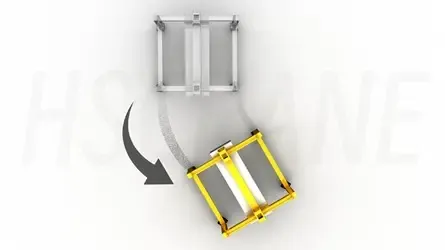
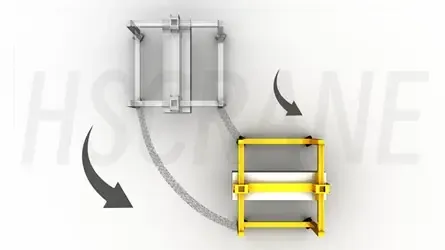
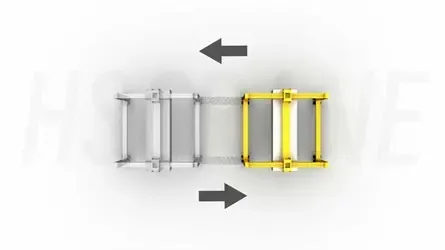
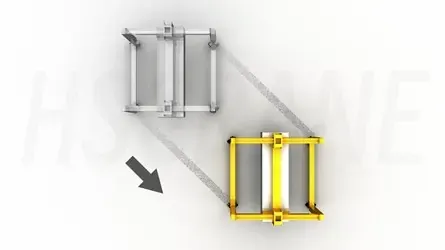
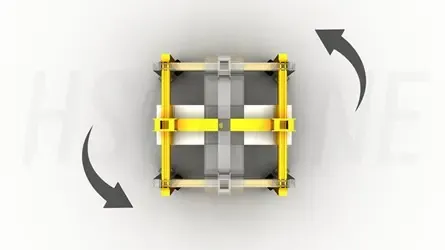
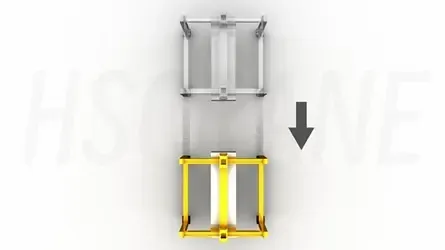
Front-wheel and Ackermann modes suit normal travel. Crab and four-way modes let the machine move sideways into a lift position. Carousel steering helps rotate long loads in a compact yard. The final selection depends on aisle width, load length and how often the operator has to reposition.
How to choose the right type
- Start with the load. Weight, dimensions, centre of gravity and lifting points. A long beam and a dense coil of the same weight need different frames.
- Map the route. Measure the narrowest aisle, the tightest turn, door heights and any floor loading limits.
- Decide the lift. Required height, stacking arrangement and whether the load has to be rotated or placed precisely.
- Check the ground. Surface type, slab thickness, drains and slopes determine tyre and wheel configuration.
- Choose drive and control. Diesel, electric or hybrid; cab or remote; local voltage and safety rules.
Types FAQ
Is a travel lift a type of straddle carrier?
It is a related straddle-style machine, but it is engineered for hulls and heavy modules with wide slings and very low travel speeds. It is not a container carrier with a different spreader.
Can one machine handle containers and precast?
Sometimes, with a interchangeable spreader and frame, but the economics are usually better with a machine configured for the dominant duty. Mixing very different loads often compromises aisle width, lifting height or ground pressure.
What capacity do I need for a 40 ft container?
A loaded 40 ft container is commonly in the 30–40 t range, but the machine rating must include the spreader, dynamic factors and any twin-lift requirement. A 35–45 t machine is a common starting point.
Can the machine work indoors?
Yes, with electric or hybrid drive and a charging/ventilation plan. Check floor loading, door height and fire strategy before selecting the battery or diesel package.