
HSCRANE has been manufacturing lifting equipment since 1998. The product range includes straddle carriers, rubber tyred gantry cranes, travel lifts and special handling machines, supported by the same engineering and fabrication team.
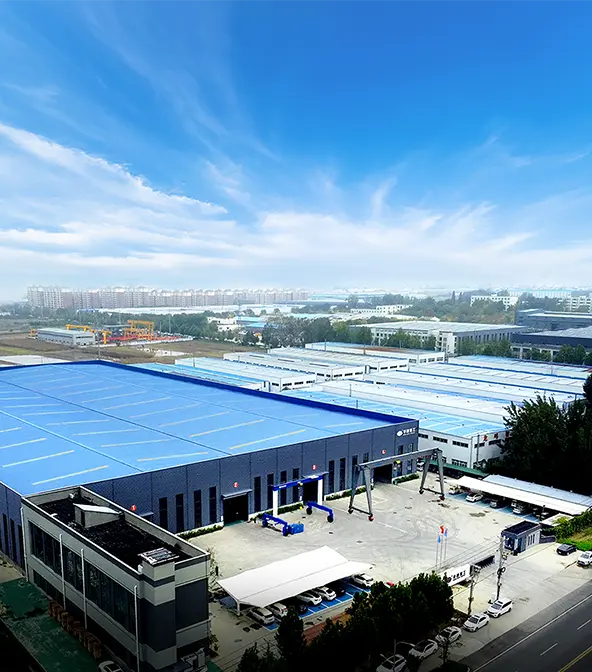
The factory is organised around heavy fabrication, machining, assembly and testing. That matters for straddle carriers because the frame, legs and boom are usually project-specific: the machine has to be built to the load and the route, not assembled from a fixed kit.
The factory in numbers
Production is supported by a semi-finished product workshop, a fully automatic welding line, a 1000 t structure forming machine and a precision machining workshop. These are the assets that make long portals, heavy legs and custom frames practical to build.
From steel to tested machine
- Design and detailing. The load, route and site constraints are converted into a frame, wheel arrangement and lifting system.
- Cutting and forming. Steel sections are cut and formed; the 1000 t structure forming machine handles heavy plates and long members.
- Welding. The automatic welding line and skilled welders assemble the main structure. Weld quality is inspected before the next stage.
- Machining. Pin holes, mounting faces and drive interfaces are machined for alignment.
- Assembly. Wheels, drive, hydraulic system, cab, electrical panels and lifting frame are installed.
- Testing. No-load and load tests check the hoist, steering, brakes, limits and controls before shipment.
- Preparation for shipment. The machine is protected, documented and packed for the site.
Quality control
Quality control is built into the production route rather than added at the end. The checks include incoming steel, weld inspection, dimensional checks, hydraulic and electrical tests, load testing and a final functional inspection. The company operates an ISO 9001 quality management system.
Market-specific certification is confirmed per project. Certificate scope and numbers are provided with the quotation when they apply to the destination market; we do not publish generic claims without the paperwork.
Global delivery
Machines have been delivered to customers across five continents, including Russia, Australia, Qatar, Saudi Arabia, Brazil and Nigeria. Export projects typically include technical drawings, packing, shipping documents and commissioning support. The exact scope is agreed in the quotation.
Why the factory matters for a custom machine
- One team from design to test. The people who detail the frame also see it through fabrication and assembly.
- Heavy fabrication capability. Long portals and high-capacity frames need forming, welding and machining capacity, not just assembly space.
- Project-specific testing. A 35 t container carrier and a 300 t precast machine are tested against different loads and procedures.
- Export experience. Documentation, packing and commissioning are part of the project, not an afterthought.
Project gates in a custom build
A custom straddle carrier is not released to the shop floor in one go. It passes through a series of gates, and each gate is a point where the buyer can still change something without paying for rework.
- Design freeze. Load data, route survey and site constraints are converted into a general arrangement drawing. Nothing is cut until you have reviewed and signed it.
- Fabrication release. Material is allocated, weld procedures are issued and the frame is detailed into shop drawings. Changes after this point affect material already cut.
- Pre-assembly and fit-up. The structure is trial-assembled before painting, so pin holes, mounting faces and clearances are checked while adjustment is still cheap.
- Factory acceptance test. No-load and load tests cover hoist, steering, brakes, limits and controls. Test weights, procedure and acceptance criteria are agreed before the test, not after.
- Packing and shipment release. The machine is protected, marked, documented and packed against the transport method.
If your project has a third-party inspector or a notified body involved, tell us at enquiry stage. Inspection points are much easier to schedule into the route than to add at the end.
What a factory audit should check
Buyers increasingly visit before placing an order, and a factory visit is most useful when it is specific. These are the things worth asking to see, rather than a walk past the assembly bay.
- Fabrication capacity against your machine. Can the bays and lifting equipment handle your portal length and frame weight, or will sections be built outdoors?
- Welding records. Weld procedures and welder qualification certificates, plus how weld inspection is recorded and traced back to a structure.
- Machining capability. Pin holes and mounting faces need boring and milling after welding; ask how alignment is recovered after distortion.
- Test area and test weights. A load test needs calibrated weights and a procedure. Ask what the machine will be tested against.
- Surface preparation and paint. Blasting grade, coating system and dry film thickness checks determine how the machine looks after two years at a port.
- Traceability. Whether steel grades and bought-in components can be traced from certificate to machine.
Packing, shipping and site readiness
Large carriers rarely travel as a complete machine. Depending on overall dimensions and the route to site, the structure is shipped in sections or as a partial assembly, then joined and commissioned on site. The packing method follows from the transport study: flat racks and containers for compact frames, breakbulk or heavy lift for long portals.
Every shipment leaves with a packing list, general arrangement and foundation or track drawings, the operation and maintenance manual, and the test records. Lifting and lashing points are marked on the structure so the receiving site does not have to guess.
On the receiving side, the site needs a hardstanding that can take the delivery vehicle and the unloading crane, enough space to assemble sections, and power for commissioning. Where a section cannot be road-transported, we agree the split points with your transport contractor before fabrication starts. The case library shows machines at the upper end of that range, and the precast page covers the long-load cases where transport planning matters most.
Factory FAQ
Can we visit the factory?
Yes. Factory visits can be arranged during the project evaluation. We recommend scheduling before the design freeze so the engineering team can review the load and route with you.
Do you build the whole machine in-house?
Main structure, assembly and testing are carried out at the Changyuan base. Major bought-in components such as engines, bearings, hydraulics and electrical parts come from established suppliers and are integrated and tested in-house.
What is the typical lead time?
It depends on capacity, configuration and current production load. A standard container carrier is shorter than a 300 t custom frame. We confirm the schedule after the technical scope is fixed.
Can you support installation and commissioning?
Yes, commissioning support can be included in the delivery scope. The exact arrangement — remote support, supervisor visit or full installation — is agreed in the quotation.